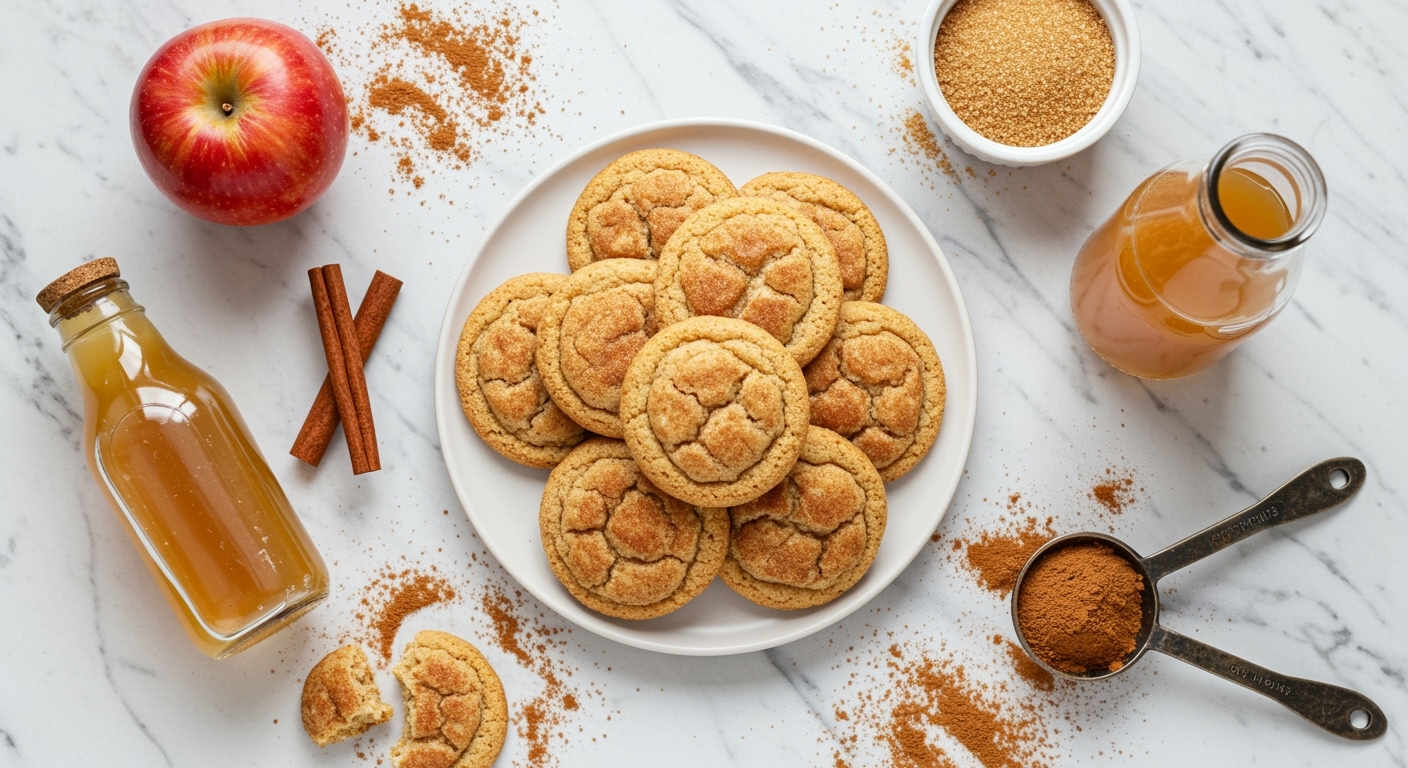
✪ Key Takeaway: Apple cider snickerdoodles combine tangy apple cider with cinnamon sugar coating to create soft, chewy cookies perfect for fall gatherings.
Introduction
Imagine biting into a warm cookie that tastes like autumn wrapped in cinnamon sugar.
The soft center melts on your tongue while the crispy edges provide that satisfying crunch you crave.
What makes this recipe better than regular snickerdoodles is the apple cider that adds a subtle tangy sweetness without making the cookies cakey or dense.
Hi, I am Abdur, your nutrition coach and today I am showing you exactly how to make apple cider snickerdoodles that disappear from your cookie jar faster than you can say fall baking.
What’s the Origin of This Recipe?
The classic snickerdoodle has German and Dutch roots dating back to the late 1800s in New England.
Some food historians believe the name comes from the German word schneckennudeln, which refers to a type of snail-shaped pastry.
The apple cider twist is a modern American innovation that emerged in the early 2000s when home bakers started experimenting with seasonal ingredients.
New England apple orchards inspired bakers to combine their fresh pressed cider with traditional cookie recipes.
Today, this variation has become a fall favorite across America, especially in regions where apple harvesting is a cultural tradition.
✪ Fact: Traditional snickerdoodles were originally made with sour cream or buttermilk before cream of tartar became the standard ingredient.
Is This Recipe Healthy?
Apple cider snickerdoodles contain refined sugar and butter, making them a treat rather than a health food.
Each cookie provides approximately 120 calories with about 5 grams of fat and 17 grams of carbohydrates.
The apple cider adds trace amounts of potassium and vitamin C, though the quantities are minimal after baking.
Cinnamon provides antioxidants and may help regulate blood sugar levels, though one cookie will not deliver therapeutic amounts.
You can make these cookies slightly healthier by using whole wheat flour for half the all-purpose flour, reducing sugar by 25 percent, or substituting coconut oil for butter without dramatically changing the texture.
✪ Total Time: 30 minutes | ✪ Total servings: 24
Tools
- Mixing bowls (2 medium, 1 small)
- Electric mixer or whisk
- Measuring cups and spoons
- Baking sheets (2)
- Parchment paper or silicone baking mats
- Cookie scoop or tablespoon
- Wire cooling rack
- Small saucepan
✪ Pro Tip: Use a cookie scoop to ensure uniform size so all cookies bake evenly at the same rate.
Ingredients
For the cookies:
- 1 cup apple cider
- 2 and 3/4 cups all-purpose flour
- 2 teaspoons cream of tartar
- 1 teaspoon baking soda
- 1/2 teaspoon salt
- 1 cup unsalted butter (softened)
- 1 and 1/2 cups granulated sugar
- 2 large eggs
- 1 teaspoon vanilla extract
For the coating:
- 1/3 cup granulated sugar
- 1 tablespoon ground cinnamon
✪ Note: Room temperature butter and eggs mix more easily and create better cookie texture than cold ingredients.
Instructions
- Pour the apple cider into a small saucepan and bring to a boil over medium-high heat.
- Reduce heat to medium and simmer until the cider reduces to about 1/4 cup, which takes approximately 15 to 20 minutes.
- Let the reduced cider cool completely while you prepare the other ingredients.
- Preheat your oven to 350 degrees Fahrenheit and line two baking sheets with parchment paper.
- Whisk together the flour, cream of tartar, baking soda, and salt in a medium bowl.
- Beat the softened butter and 1 and 1/2 cups sugar in a large bowl with an electric mixer until light and fluffy, about 3 minutes.
- Add the eggs one at a time, beating well after each addition.
- Mix in the vanilla extract and cooled reduced apple cider until combined.
- Gradually add the flour mixture to the wet ingredients, mixing on low speed until just combined.
- Combine the 1/3 cup sugar and cinnamon in a small bowl for the coating.
- Scoop about 2 tablespoons of dough and roll into a ball.
- Roll each dough ball in the cinnamon sugar mixture until completely coated.
- Place the coated dough balls on the prepared baking sheets, spacing them about 2 inches apart.
- Bake for 10 to 12 minutes until the edges are set but the centers still look slightly underbaked.
- Let the cookies cool on the baking sheet for 5 minutes before transferring to a wire rack.
- Allow cookies to cool completely before storing or serving.
✪ Pro Tip: Slightly underbaking creates that perfect chewy center while the edges remain crisp and golden.
Nutrition Facts (approximate)
Per cookie:
- Calories: 120 kcal
- Protein: 2g
- Carbohydrates: 17g
- Fat: 5g
- Fiber: 0.5g
- Sugar: 10g
- Sodium: 85mg
✪ Note: These values are estimates based on standard ingredient measurements and may vary depending on specific brands used.
What Are Common Mistakes to Avoid?
The biggest mistake people make is not reducing the apple cider enough, which creates wet dough that spreads too much during baking.
You need to simmer the cider until it becomes thick and syrupy, resembling the consistency of honey.
Another common error is using cold butter instead of properly softened butter, which prevents the dough from mixing smoothly and creates dense cookies.
Overbaking these cookies is the third major pitfall because they continue cooking on the hot baking sheet after you remove them from the oven.
If the centers look completely set when you take them out, they will become hard and dry instead of soft and chewy once cooled.
✪ Pro Tip: The cookies should look slightly puffy and underdone in the center when you remove them from the oven.
What If You’re Missing an Ingredient?
If you do not have apple cider, you can substitute with unsweetened apple juice reduced the same way, though the flavor will be slightly less complex.
Missing cream of tartar is trickier because it provides the signature tangy flavor, but you can use 1 tablespoon of white vinegar or lemon juice as a substitute.
For butter, you can use coconut oil in equal amounts, though the cookies will have a slightly different texture and a hint of coconut flavor.
If you are out of eggs, use 2 tablespoons of unsweetened applesauce per egg, but expect slightly cakier cookies with less chewiness.
You cannot skip the cinnamon sugar coating without losing the essential snickerdoodle character, so this ingredient is truly non-negotiable.
✪ Fact: Cream of tartar is actually a byproduct of wine making and helps create the characteristic tangy flavor in snickerdoodles.
Can You Store Leftovers?
These cookies stay fresh at room temperature for up to 5 days when stored in an airtight container.
Place a piece of bread in the container with the cookies to help maintain their soft texture by providing moisture.
For longer storage, you can freeze baked cookies for up to 3 months in a freezer-safe container with parchment paper between layers.
You can also freeze the unbaked dough balls after rolling them in cinnamon sugar, then bake directly from frozen by adding 2 extra minutes to the baking time.
The cinnamon sugar coating may absorb some moisture over time, so these cookies taste best within the first 2 to 3 days after baking.
✪ Pro Tip: Warm stored cookies in the microwave for 10 seconds to restore that fresh-baked softness and aroma.
Can You Scale This Recipe?
This recipe scales easily in both directions without requiring special adjustments to baking time or temperature.
To make a half batch, simply divide all ingredients by two, but remember you still need to reduce the apple cider to the same syrupy consistency.
For a double batch, multiply everything by two and reduce the apple cider in a larger pan to save time.
When making larger quantities, you may need to bake the cookies in multiple batches unless you have several baking sheets and oven space.
The dough can sit at room temperature for up to an hour while you bake batches, or you can refrigerate it and let it come to room temperature before scooping.
✪ Note: Always reduce apple cider to one-quarter of its original volume regardless of batch size for proper consistency.
Can You Customize This Recipe?
You can add chopped pecans or walnuts to the dough for extra crunch and nutty flavor that complements the apple cider.
Try mixing in dried apple pieces or raisins for more concentrated fruit flavor and chewy texture throughout the cookies.
For a spicier version, add 1/4 teaspoon of nutmeg, ginger, or allspice to the dry ingredients along with the cinnamon.
You can make these cookies vegan by using plant-based butter, flax eggs (1 tablespoon ground flaxseed plus 3 tablespoons water per egg), and ensuring your sugar is vegan-friendly.
For a gluten-free option, substitute the all-purpose flour with a one-to-one gluten-free baking flour blend, though the texture may be slightly more crumbly.
✪ Pro Tip: Add a pinch of cardamom to the cinnamon sugar coating for an unexpected aromatic twist that elevates these cookies.
The Bottom Line
Apple cider snickerdoodles bring together the best of fall baking with minimal effort and maximum flavor that everyone loves.
The secret to perfect cookies is patience with the apple cider reduction and courage to pull them from the oven when they still look slightly underdone.
I would love to hear how your batch turned out, what variations you tried, or any questions you have about making these cookies in the comments below.
References
At NutritionCrown, we use quality and credible sources to ensure our content is accurate and trustworthy. Below are the sources referenced in writing this article:
- Beyond the Chicken Coop: Apple Cider Snickerdoodles
- Healthienut: Apple Cider Snickerdoodles
- King Arthur Baking: Apple Cider Snickerdoodles Recipe
- Institute of Culinary Education: Understanding the Science of Cookies
- National Center for Biotechnology Information: Baking Therapy Research