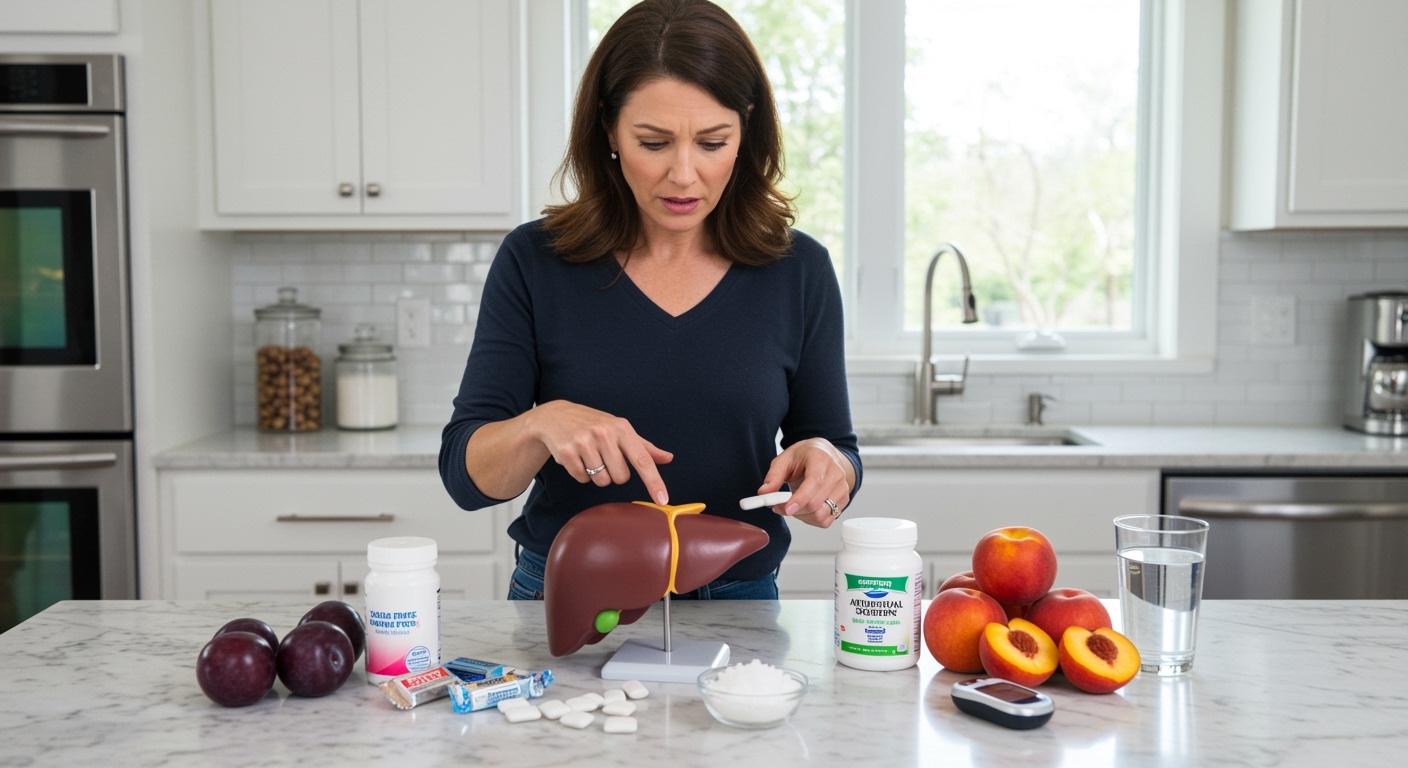
✪ Key Highlight: Sorbitol in sugar-free products converts to fructose in your liver, causing fatty liver disease even in healthy individuals.
Introduction
You reach for that sugar-free gum thinking you made a healthy choice.
But new research from Washington University reveals that sorbitol, the common sweetener in that gum, might be quietly damaging your liver in ways you never imagined.
Hi, I am Abdur, your nutrition coach and today I am going to analyze the groundbreaking study that exposes how sorbitol converts to fructose inside your body, triggering the same liver damage as regular sugar consumption.
What Did Scientists Discover About Sorbitol?
Researchers at Washington University conducted experiments with zebrafish to understand how sorbitol affects liver health.
They discovered that sorbitol is essentially one chemical transformation away from becoming fructose inside your body.
This means when you consume sorbitol from sugar-free candy, gum, or beverages, your body can convert it into the same harmful sugar you were trying to avoid.
The study was published in Science Signaling and builds on previous research from Gary Patti’s laboratory that detailed how fructose damages the liver.
What makes this discovery alarming is that sorbitol appears in thousands of products marketed as healthier alternatives to sugar.
The research team found that sorbitol can be naturally produced in your gut from glucose after eating, not just consumed from external sources.
This dual pathway means your liver faces potential fructose exposure even when you think you are avoiding it completely.
✪ Fact: Sorbitol naturally occurs in stone fruits like plums, peaches, and apricots, but processing concentrates it to much higher levels in commercial products.
How Does Your Body Produce Sorbitol Naturally?
Your body contains an enzyme that can convert glucose into sorbitol naturally in your intestines.
This enzyme has a low affinity for glucose, meaning it only activates when glucose levels become significantly elevated.
Scientists previously believed this sorbitol production only occurred in diabetic conditions where blood sugar levels remain chronically high.
However, the zebrafish experiments revealed that even in healthy individuals, glucose levels in the gut become high enough after meals to trigger sorbitol production.
This happens because the concentration of glucose in your intestines immediately after eating can be much higher than in your bloodstream.
The research challenges the conventional understanding that only diabetics need to worry about internal sorbitol production.
According to Gary Patti, there are many roads to fructose in the liver, and potential detours, depending on your sorbitol and glucose consumption patterns along with the bacterial populations colonizing your gut.
✪ Note: The enzyme that converts glucose to sorbitol is called aldose reductase, and it becomes more active as glucose concentrations rise in your intestinal tract.
Why Do Gut Bacteria Matter So Much?
The critical factor determining whether sorbitol becomes problematic is the presence of specific bacteria strains in your gut.
Researchers identified Aeromonas bacterial strains that can break down sorbitol into harmless byproducts before it reaches your liver.
If you have these protective bacteria in sufficient quantities, sorbitol metabolism does not become an issue because these microorganisms degrade it efficiently.
However, if you lack these specific bacteria, sorbitol passes through your intestines unchanged and travels to your liver.
Once in the liver, sorbitol undergoes conversion into fructose-like molecules that trigger the same metabolic damage associated with high-fructose diets.
The research team observed that problems arise when glucose or sorbitol intake becomes excessive because gut microbes cannot keep up with the metabolic demand.
This imbalance pushes sorbitol metabolism into overdrive, contributing to fatty liver changes and systemic inflammation that characterize steatotic liver disease.
✪ Pro Tip: Supporting diverse gut bacteria through fermented foods and fiber may help your body handle sorbitol more effectively, though research is still ongoing.
What Is Steatotic Liver Disease?
Steatotic liver disease, also known as fatty liver disease, affects approximately 30 percent of the adult population worldwide.
This condition represents the most common cause of chronic liver disease globally.
The disease occurs when fat accumulates in liver cells, impairing the organ’s ability to perform its vital functions like detoxification and metabolism.
The zebrafish experiments demonstrated that sorbitol, whether naturally produced in the gut or consumed from dietary sources, can accumulate in the liver and trigger metabolic changes associated with this disease.
Even low doses of sorbitol, similar to what you might consume in everyday low-calorie foods, could end up being converted into harmful metabolic byproducts.
These byproducts damage liver function by promoting fat accumulation and triggering inflammatory responses.
The study found that the liver processes sorbitol through the same pathways as fructose, leading to similar patterns of metabolic dysfunction.
✪ Fact: Fatty liver disease often develops silently without symptoms until significant damage has occurred, making prevention through dietary awareness crucial.
Should You Stop Using Sugar-Free Products?
The research raises important questions about how sugar-free labeling is understood and used by consumers.
Many people believe they are making healthier choices by avoiding regular sugar and choosing products sweetened with sorbitol.
However, Dr. Patti emphasizes that there is no free lunch when it comes to artificial sweeteners.
Even sugar alcohols thought to pass harmlessly through the body can end up influencing the same pathways as sugar itself.
The study suggests a need for reevaluating sugar-free labeling and understanding how both diet and microbiome diversity shape our metabolic health.
This research opens new possibilities for understanding individual responses to sweeteners based on unique gut bacterial composition.
Future dietary recommendations may need to be personalized based on microbiome analysis rather than one-size-fits-all guidelines.
✪ Note: Reading ingredient labels remains essential because sorbitol appears under various names including glucitol and E420 in different countries.
The Bottom Line
This groundbreaking research reveals that sorbitol is not the harmless sugar substitute many believed it to be.
The safety of any sweetener depends not just on the compound itself but on the complex interplay between your diet, gut bacteria, and liver metabolism.
I would love to hear your thoughts on this research and whether it changes how you view sugar-free products, so please share your questions or experiences in the comment section below.
References
At NutritionCrown, we use quality and credible sources to ensure our content is accurate and trustworthy. Below are the sources referenced in writing this article:
- Science: Gut microbiota-dependent sorbitol metabolism contributes to hepatic fructose accumulation in zebrafish
- Medical Dialogues: Alternative Sweetener Sorbitol Linked to Liver Disease, Suggests Study
- ScienceDaily: Scientists link popular sugar substitute to liver disease
- SciTechDaily: Scientists Link Popular Sugar Substitute to Liver Disease
- Diabetes.co.uk: Sorbitol and the liver: Why some sugar substitutes may not be harmless