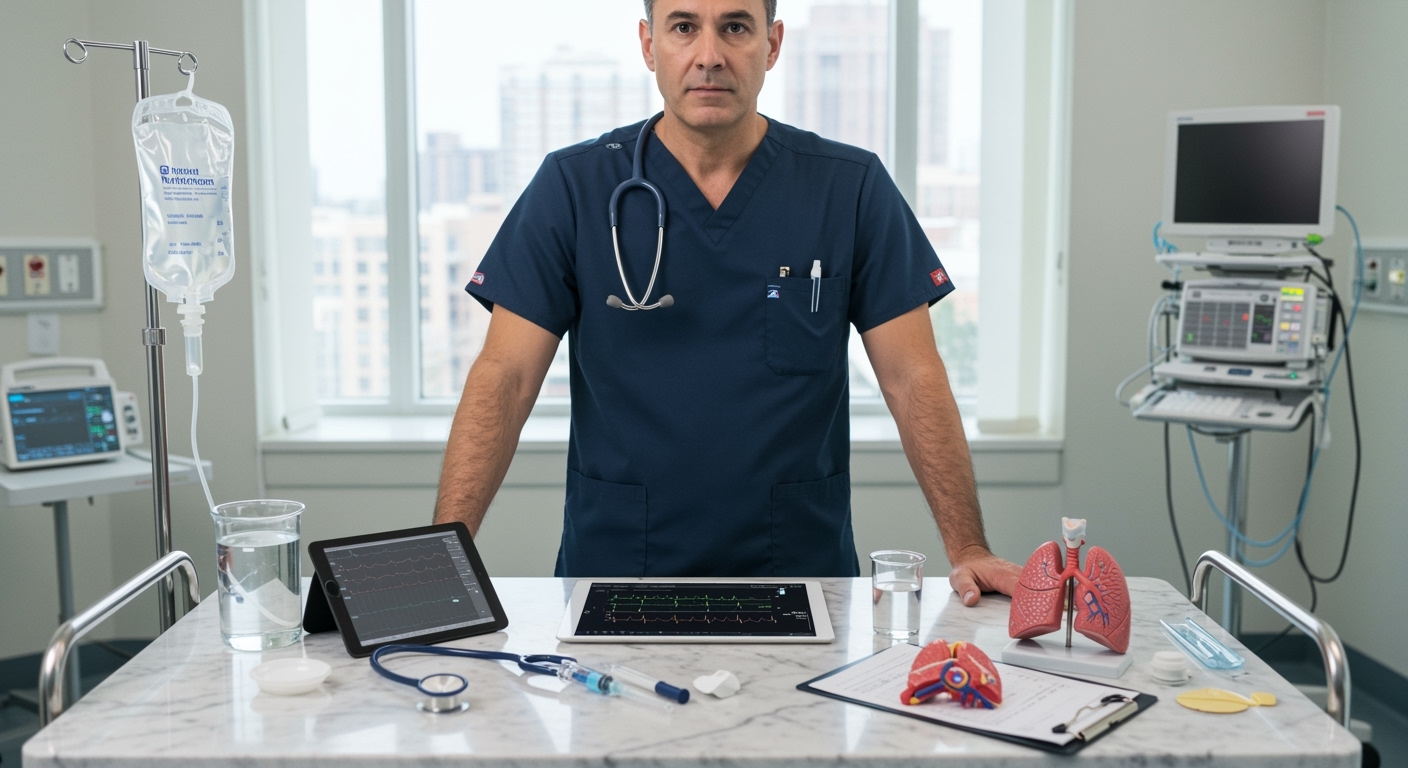
✪ Key Highlight: New AI tool predicts ICU underfeeding hours ahead, helping doctors prevent malnutrition in 41-53% of ventilator patients.
Introduction
Imagine fighting for your life on a ventilator while your body slowly starves.
This nightmare happens to nearly half of all ICU patients during their first critical week, when proper nutrition matters most for survival and recovery.
Hi, I’m Abdur, your nutrition coach, and today I’m going to analyze how researchers at Mount Sinai created an AI prediction tool called NutriSighT that spots underfeeding risk in ventilator patients hours before it happens.
Why Do ICU Patients Miss Vital Nutrition?
Critically ill patients on mechanical ventilators face rapidly changing medical conditions every single hour.
Their bodies demand precise amounts of calories and protein to fight infection, heal wounds, and maintain organ function.
However, medical teams must constantly adjust medications, manage blood pressure changes, and respond to complications.
These urgent interventions often interrupt feeding schedules, causing patients to fall behind on nutrition without anyone noticing immediately.
The research published in Nature Communications revealed that 41 to 53 percent of patients experience underfeeding by day three of ventilation.
Even by day seven, when medical teams have more experience with each patient, 25 to 35 percent still receive inadequate nutrition.
This gap happens because doctors and nurses lack a simple way to predict which patients will miss their nutritional targets before the damage occurs.
✪ Fact: Enteral nutrition means feeding through a tube directly into the stomach or intestines when patients cannot eat normally.
How Does NutriSighT Predict Underfeeding Risk?
The AI tool works by scanning everyday ICU data that medical teams already collect for other purposes.
It analyzes vital signs like heart rate and blood pressure, laboratory results including sodium and albumin levels, current medications, and detailed feeding records.
NutriSighT updates its predictions every four hours as patient conditions shift throughout the day and night.
The system predicts underfeeding risk hours ahead of when it actually happens, giving medical teams time to adjust care plans.
Researchers trained this model using large datasets from both European and American intensive care units, focusing specifically on days three through seven of mechanical ventilation.
What makes NutriSighT special is its ability to explain its predictions in terms doctors understand.
The tool highlights specific factors like low blood pressure, abnormal sodium levels, or heavy sedation that increase underfeeding risk for each individual patient.
✪ Pro Tip: Mechanical ventilation means a machine breathes for patients when their lungs cannot work properly on their own.
What Makes Early Nutrition So Critical?
The first week on a ventilator represents the most dangerous period for critically ill patients.
Their bodies enter a hypermetabolic state, burning through energy stores faster than healthy people do during intense exercise.
Without adequate nutrition, patients lose muscle mass rapidly, including the respiratory muscles they need to eventually breathe without the ventilator.
Their immune systems weaken, making infections more likely and harder to fight off.
Wound healing slows down, and organs like the heart and kidneys struggle to maintain normal function without proper protein and calories.
Dr. Ankit Sakhuja, the study’s co-senior author, explained that patient needs change so rapidly that it becomes easy for them to fall behind on nutritional support.
The goal is identifying who faces the highest risk early enough that clinicians can intervene, adjust care, and ensure each patient receives appropriate support when it matters most.
✪ Note: APACHE II and SOFA scores measure disease severity in ICU patients using vital signs, lab values, and organ function.
Will This Replace Doctors And Dietitians?
Absolutely not, and the researchers make this point crystal clear.
NutriSighT acts as an early warning system, not a replacement for human expertise and clinical judgment.
The tool provides timely information that helps doctors and dietitians make better decisions faster.
Think of it like a smoke detector in your home that alerts you to danger before fire spreads.
The detector does not put out fires, but it gives you precious time to act before serious damage occurs.
Dr. Girish Nadkarni, Chair of the Department of Artificial Intelligence and Human Health at Mount Sinai, emphasized that this represents an important step toward giving clinicians better information for nutrition decisions.
The ultimate goal is providing the right amount of nutrition to the right patient at the right time, which could improve recovery and outcomes while laying groundwork for more personalized care strategies.
✪ Fact: Mount Sinai’s previous AI tool NutriScan won the 2024 Hearst Health Prize for detecting malnutrition faster in hospital patients.
What Happens Next With This Technology?
The research team plans multi-site clinical trials to test whether these predictions actually improve patient outcomes in real-world settings.
They need to prove that catching underfeeding early leads to better survival rates, shorter hospital stays, and faster recovery times.
The next major step involves smooth integration into electronic health records that hospitals already use every day.
Doctors and nurses should not need special training or extra time to benefit from these AI predictions.
Other research teams worldwide are exploring similar approaches using different machine learning methods.
One study from Zhejiang Province in China used logistic regression, support vector machines, and random forest models on 487 ICU patients to predict feeding intolerance with high accuracy.
Another study published in the Asia Pacific Journal of Clinical Nutrition built an explainable AI model on 2,122 patients that outperformed traditional NUTRIC scores for identifying high nutrition risk based on age, BMI, albumin levels, and disease severity markers.
✪ Pro Tip: The NUTRIC score is a traditional assessment tool that estimates nutrition risk in ICU patients using clinical variables.
The Bottom Line
This breakthrough shows how artificial intelligence can solve real problems that harm vulnerable patients every single day.
Technology serves medicine best when it amplifies human expertise rather than replacing the irreplaceable judgment of trained professionals.
What are your thoughts on using AI tools to improve patient care in intensive care units, and do you have questions about how nutrition affects recovery from critical illness? Share your perspective in the comments below.
References
At NutritionCrown, we use quality and credible sources to ensure our content is accurate and trustworthy. Below are the sources referenced in writing this article:
- Mount Sinai: AI Could Help Predict Nutrition Risks in ICU Patients, Study Finds
- PubMed: NutriSighT: Interpretable Transformer Model for Dynamic Prediction
- Asia Pacific Journal of Clinical Nutrition: Explainable AI Model for Nutrition Risk Prediction
- News Medical: Early Identification of Nutrition Risk in ICU Patients Using AI